



Field Drying in November: Why Moisture Loss Slows

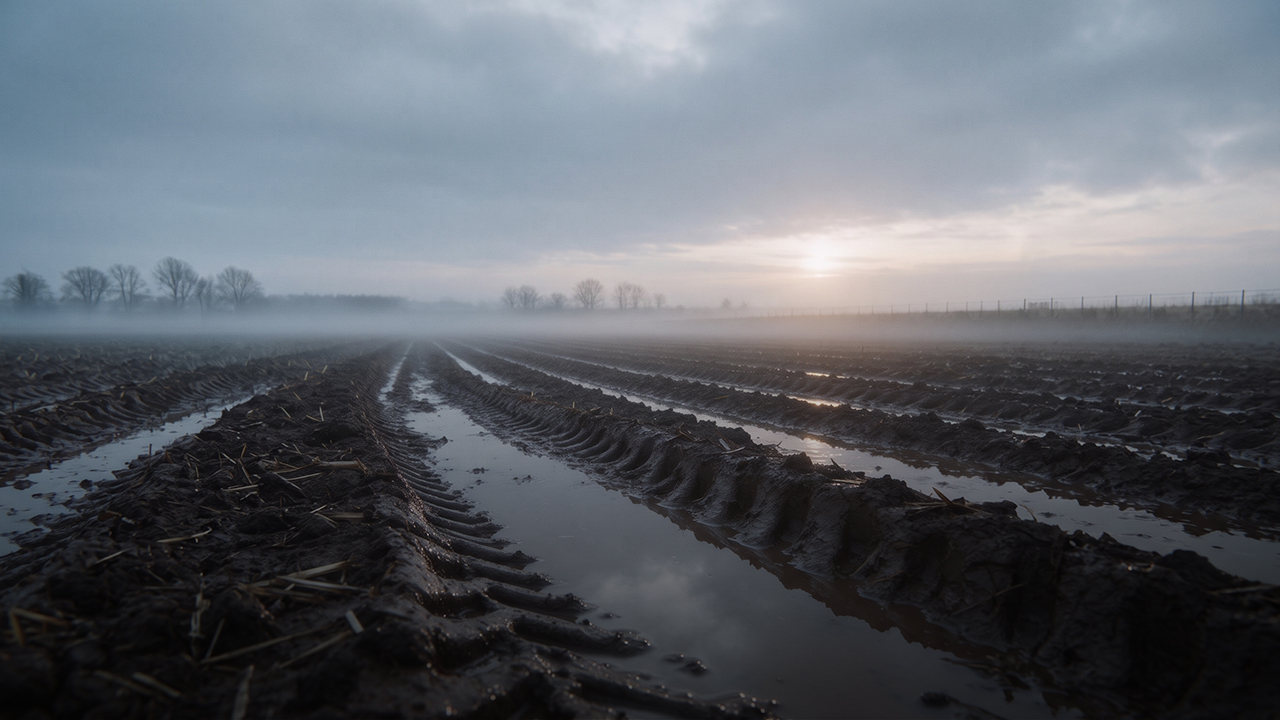
Field drying in November can become significantly slower as colder temperatures, shorter days, high humidity and frequent rainfall limit the amount of moisture crops can lose naturally. In northern North America the cooler temperatures, shorter days and damp weather are all working to reduce the time available for the standing crop to dry down as harvest is being pushed further and further back. Drying will vary from field to field though. Crop maturity, planting date and ear characteristics all play a part. Knowing the effect of these things will help the farmer to determine whether it is worth waiting for some additional drying or whether waiting may expose the crop to greater harvest risks.
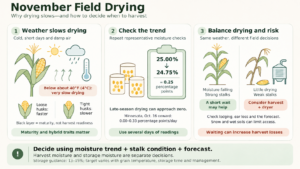
Why November Weather Slows Field Drying
After physiological maturity, the kernels lose most of their additional moisture through evaporation. Warm, sunny, dry and breezy weather is ideal. November is often the opposite of this: it’s cooler, there’s less solar energy and there are fewer daylight hours. Below about 40°F (4°C) the air has very little capacity to take up any further moisture so drying can become extremely slow.
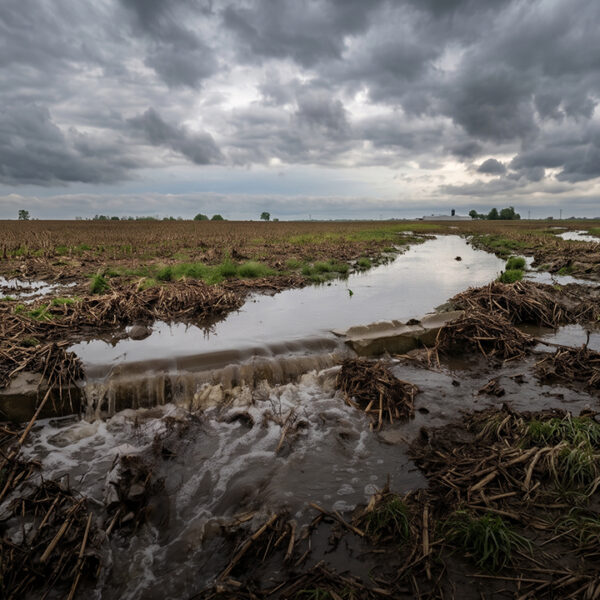
High humidity, cloud cover and frequent rain all work to reduce drying potential. Rain will wet the husks and the plant surfaces and can keep the crop environment damp; it doesn’t necessarily mean that every shower is going to add moisture to the kernels. Wind can be of benefit when the air is dry, but it won’t make up for persistently cold and humid conditions. It’s a combination of factors so a short spell of sun may do something, several days of cold and wet will do very little.
Maturity, Planting Date and Hybrid Characteristics Matter
Physiological maturity is when the black layer forms at the kernel base and dry matter accumulation is complete. Kernel moisture at this point is around 30% (Purdue reports a range of 25% to 40% depending on the hybrid and growing conditions). The black layer indicates maturity, not harvest readiness, because the kernels still have to dry down.
Late planting and later maturing hybrids can reach maturity when the days are getting shorter and the temperatures are dropping. Ear and husk characteristics are also important. Fewer, thinner or looser husk leaves, less coverage over the tip of the ear and ears that are turned down will all tend to promote faster moisture loss. Thick, tight husks and upright ears will tend to slow drying or hold the rain.
What November Drying Rates Can Tell Us
University of Minnesota guidance provides a typical Minnesota field drying rate of 0.00 to 0.33 percentage points per day from October 16 onward. A 2025 NDSU report estimated 0 to 0.3 points per day in the second half of October and stated that very little drying would be expected after October 31. Purdue notes that Indiana rates could be zero by early to mid November.
A percentage point change is not the same as a percentage change. A drop from 25.00% to 24.75% moisture is 0.25 percentage points. These are not universal figures as the local weather will have a bearing on the rate. Repeated moisture measurements from representative samples over a number of days will tell you whether drying is actually continuing at a meaningful rate; a single reading will not.
When Waiting Creates Harvest Risks
Lower grain moisture has to be balanced against the condition of the standing crop. Stalk rot, disease, insects or prior stress can all weaken the stalk and ear shank and increase the risk of lodging or ear drop. Wildlife feeding can also lead to a reduction in harvestable grain. Fields that are already leaning or dropping ears may need to be looked at earlier.
A freeze prior to physiological maturity can damage the plant and interrupt grain fill. Freeze affected areas may dry differently and have weaker stalks. After maturity, though, cold weather mainly limits further drying. Snow and wet soils present a different problem in that they will obviously restrict field access and delay the harvest.
Two Neighboring Fields, Two Different Decisions
Imagine two adjacent fields facing the same November forecast. One was planted earlier with a faster maturing hybrid and looser husks. Its moisture is still going down and the stalks are still quite strong. A short delay might be acceptable if the forecast holds.
The second one was planted later with a later hybrid and tighter husks. The readings have not changed much and some of the stalks are starting to weaken. There’s probably very little extra drying to be gained by waiting and the risk of lodging and/or ear loss may be increased. If the farm has the capacity then harvesting earlier and using a mechanical dryer may be the way to go.
For storage, 15% moisture is just a common reference point; it’s not a universal target. The University of Minnesota guidance gives a safe storage range of 13% to 15%. The correct level will obviously vary depending on the grain temperature, the length of time it’s going to be stored and the management of it. Harvest moisture and storage moisture are two separate decisions.
Knowing When to Stop Waiting
November field drying is constrained by more than just the calendar. It’s the cold air, the reduced sunlight, the humidity and the rain that interact with crop maturity and hybrid characteristics to determine how much moisture the kernels can still lose. The actual decision as to whether you should wait depends on repeated moisture checks, stalk condition and the forecast. In some fields, mechanical drying may well be the safer option.