Excavator Bucket Types and Their Uses: A Practical Guide

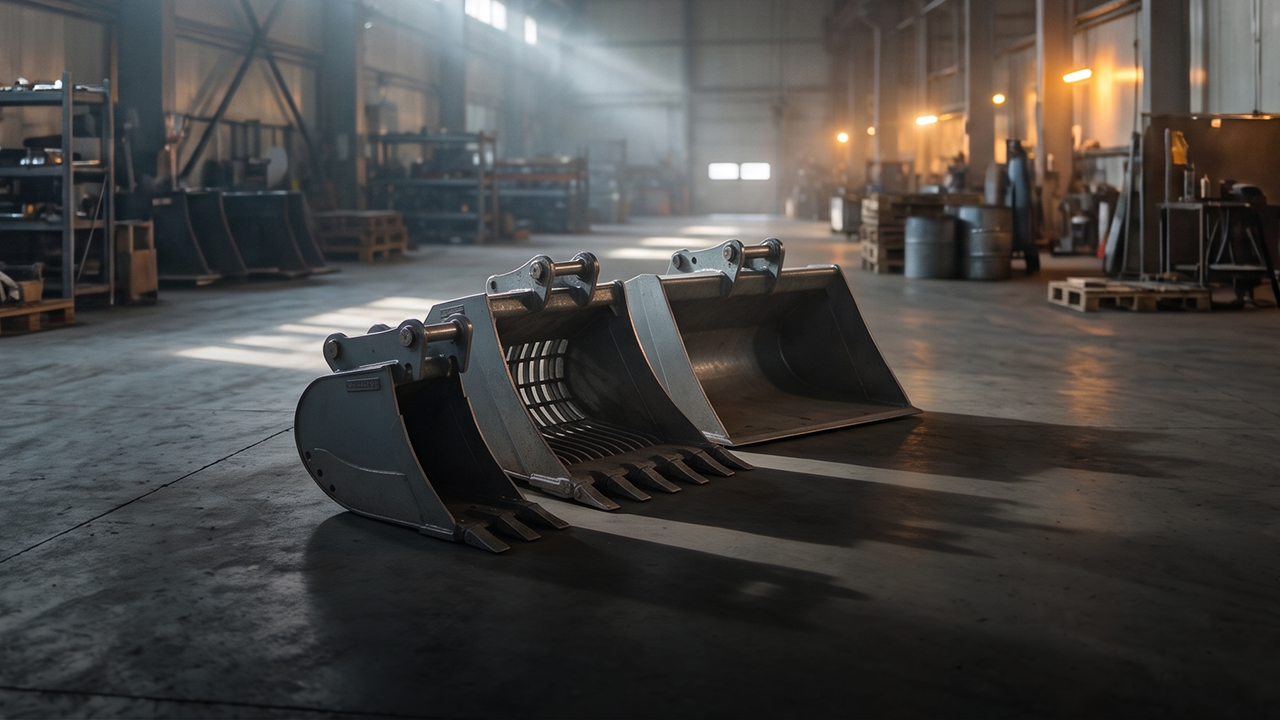
Excavator bucket types differ in shape and function. A bucket’s shape has a huge influence on how it digs, how it moves the material and how it finishes a surface. A bucket designed for digging narrow utility trenches is not necessarily the right bucket to be using when you’re spreading backfill and an open grid bucket will deal with the material in a completely different way from a solid floor bucket.
Understanding excavator bucket types is absolutely critical if you’re to get the right bucket for the job, for the ground conditions and for the machine. This guide looks at the eight bucket types as documented by equipment manufacturers, their practical applications, their pros and cons in a construction environment.
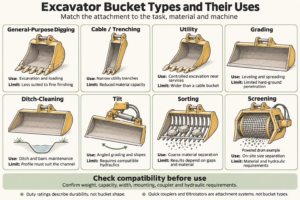
Excavator Buckets for Digging and Utility Trenches
General-Purpose (Digging) Bucket
Among excavator bucket types, the general purpose digging bucket is for general digging and loading. It has a curved body to hold the material you’ve dug up and many have teeth on them to help them get into the ground. It’s used for digging foundations, earthmoving, loading loose material and backfilling (in the right type of soil).
For instance an operator digging a building footing in normal ground would be likely to use a digging bucket to do the digging and then switch to a finishing attachment.
Its main advantage is versatility in that one bucket will do a number of the standard jobs. It won’t give you the same smooth finish as a wide grading bucket and in certain circumstances (particularly on hard, abrasive ground) you may well find that you do need a more wear resistant construction rather than a standard duty bucket.
Cable Bucket (Trenching Bucket)
A cable bucket has a fairly narrow profile, designed to dig trenches without removing unnecessary material from either side. It can have teeth or a cutting edge and its quite extended profile is of use to the operator when working around existing services.
It’s used for electrical cables, fiber optic lines, water pipes, and drainage installations. On a utility project it can be used to cut a narrow trench along a proposed service route.
The narrow cut is an advantage in the situation where you’ve got very limited excavation space. The obvious downside is the reduced material capacity as compared to a wider digging bucket. The trench dimensions are still going to be governed by the project design, the ground conditions and the relevant safety requirements. The bucket itself doesn’t make the excavation safe to enter.
Utility Bucket
A utility bucket is one of the excavator bucket types that combines features of a digging bucket and a cable bucket. It has a longer floor which gives it the reach to go around or beneath existing services and a wider body which can carry more of the material than a more narrow cable bucket.
This is useful in water and sewer work. Take the example of a contractor who’s going to be exposing a pipe down an existing utility corridor and who’s going to have to excavate around the service in a very controlled manner, while at the same time being able to remove a fair bit of soil.
Its benefit is that it can be used in the transition from narrow access excavation to material handling. It’s less suitable than a dedicated narrow cable bucket when you’re working in a very narrow trench, and in no way does it replace the need for careful excavation near underground services.
Excavator Buckets for Grading, Slopes, and Drainage
Grading Bucket
A grading bucket will normally have a broad working edge and be of a shape to allow it to spread, level and trim loose material. Many will have a fairly flat bottom and a smooth edge rather than any pronounced digging teeth.
It’s useful for finishing the building pads, shaping out the landscaped areas and distributing the backfill. Once the main bulk excavation is done you can use a grading bucket to finish the surface to the required profile.
A larger contact area means surface finishing is easier, but that very same shape isn’t quite the best for breaking into hard, compacted material. Like other excavator bucket types, grading buckets come in all sorts of shapes and the one you end up with is very much going to be a matter of what finish you’re after and what the machine is set up to do.
Ditch-Cleaning Bucket
A ditch cleaning bucket is for ditch maintenance, shaping the banks and cleaning/regrading the slopes. Its shape will generally give you a fairly wide working area for clearing the loose material and cutting the surface.
For example during drainage maintenance you’d have an operator remove the soil that’s accumulated in the ditch and then re-profile the banks. Some of the ditch cleaning buckets will also be used for backfilling and leveling lawns and embankments.
The benefit is that you can effectively profile a far greater area. The downside is that ditch-cleaning buckets aren’t necessarily designed for demanding ground penetration or heavy rock excavation. Their precise profile is also going to be dictated by the type of channel you’re trying to maintain rather than being a one size fits all.
Tilt Bucket
What sets tilt buckets apart from other excavator bucket types is the hydraulically operated tilting mechanism in the bucket itself. The operator can tilt the working edge of the bucket sideways while the excavator remains in position. Obviously very useful when working on slopes and over uneven ground.
A contractor finishing off a sloped shoulder on a road would quite possibly use a tilt bucket to follow the slope as required rather than having to reposition the excavator each time.
The primary benefit is obviously improved flexibility in terms of grading and shaping. The downside is that it introduces hydraulic components which have to be compatible with the carrier and which have to be maintained. A tilt bucket can vary its angle but in no way gives you the continuous rotation of a separate tiltrotator.
Excavator Buckets for Sorting and Screening Material
Sorting Bucket
A sorting bucket has perforations or open bars which allow the smaller bits to pass through and the larger bits are held back. It’s a bucket which is designed to sort as well as to carry the material.
On a site clearing job you could well have an operator using a sorting bucket to sort the stones and the larger bits and just let the loose soil go back to the ground. You’ve got the separation of the materials at the point of digging.
Its practical advantage is simple separation without necessarily requiring a separate processing machine. The result will of course be very much dependent on the size of the apertures, the moisture content of the material and the shape of the particles. Wet or sticky soil will not pass through as easily as dry, free flowing material.
Screening Bucket
Among excavator bucket types, a screening bucket is another attachment used to separate the material by size. The term is used quite loosely in some cases and can overlap with sorting and skeleton buckets. Some screening designs will incorporate powered drums or rotating shafts to actually get the material through the screening openings.
For example a suitable screening bucket could be used to screen the excavated soil prior to the material being selected for a permitted backfill. In certain circumstances the screening operation could reduce the volume of material which would otherwise have to be moved to a separate screening site.
Its advantage is in on-site processing where the attachment and the material are compatible. The disadvantages are that it’s not at all suitable for wet or cohesive material, the size of screen openings available and the additional hydraulic requirements of the powered units. Screening in no way guarantees that the material meets the project specification or is free from contamination.
Quick Comparison of Excavator Bucket Types
| Bucket type | Primary use | Main advantage | Main limitation |
| General-purpose digging | Excavation and loading | Versatile daily use | Less effective for fine finishing |
| Cable | Narrow utility trenches | Controlled trench width | Limited capacity |
| Utility | Excavation near services | Reach with more soil capacity | Wider than specialized cable buckets |
| Grading | Leveling and backfilling | Broad finishing edge | Limited hard-ground penetration |
| Ditch-cleaning | Drainage and slope work | Wide shaping area | Profile must match the job |
| Tilt | Angled grading | Adjustable working angle | Requires compatible hydraulics |
| Sorting | Coarse material separation | Open structure retains larger items | Depends on gap size and material condition |
| Screening | Size-based material processing | Can process material on-site | Powered versions need suitable hydraulics |
How to Choose the Right Excavator Bucket
Different excavator bucket types suit different jobs: a narrow trench requires different bucket geometry than finishing a building pad and you do need some openings (that a standard digging bucket won’t get) to separate the rock from the soil.
Next the material. Loose soil, compacted clay, abrasive aggregate and rock all affect excavator bucket types differently. Bucket duty ratings are a completely separate issue from bucket shape. The various manufacturer duty ratings (general duty, heavy duty, severe duty, extreme duty) describe durability for different conditions. They’re not four different applications or four different bucket shapes.
Finally check the excavator. The bucket weight, capacity, width, mounting dimensions, coupler type and hydraulic requirements all have to be the right ones for that particular machine.
A bucket that appears to be the right bucket for the job may still be the wrong one if it’s outside the excavator’s operating limits or simply won’t attach. Always check compatibility using the excavator and attachment documentation prior to using it.
Where Quick Couplers and Tiltrotators Fit In
Quick couplers enable compatible attachments to be changed without having to go through the same pin removal as would be required with a direct mounted bucket. A tiltrotator fits between the excavator arm and an attachment, allowing the operator to tilt and rotate compatible tools. Neither of these falls under excavator bucket types.
These systems can certainly give you a bit more scope in the way of grading and trenching, but attachment compatibility, hydraulic connections and correct locking are all still absolutely critical. A bucket with its own hydraulic tilt is a completely different proposition from a standard bucket on a tiltrotator.
Frequently Asked Questions
What’s the difference between a digging bucket and a grading bucket?
A digging bucket is one that’s designed to dig and carry the material away. A grading bucket will generally have a wider, smoother working edge for spreading and finishing.
Is a cable bucket the same as a utility bucket?
Not exactly. A cable bucket is all about a very narrow trench profile. A utility bucket can have more capacity and can be designed to go around pipes and other buried services as required.
Can all excavator bucket types fit any excavator?
No. The bucket will be dependent on the machine size, the mounting/coupler dimensions, the bucket weight and capacity and the available hydraulics for the powered attachments. You’ll need to check compatibility for the particular machine and attachment in question.
Are heavy duty and extreme duty buckets a different bucket shape?
Not necessarily. Those terms are generally used in the context of durability with respect to different impact and abrasion conditions rather than any particular bucket shape. The type of work you’re doing and the level of durability required are both obviously important when you’re selecting a bucket.
Final Considerations When Selecting Excavator Bucket Types
Choosing among excavator bucket types comes down to the work each bucket needs to perform. The shape of the bucket will be different depending on whether you’re digging, trenching, finishing or separating the material so one bucket is not going to be the right one for all jobs.
By looking at the application, ground conditions, machine compatibility and operating limits the contractor can select the appropriate attachment for the job.