
Hay Bale Heating: Understanding the Risks of Stored Hay

Freshly baled hay can appear dry and ready for storage yet still have quite a bit of moisture locked up in the stems and in the packed layers. That moisture may not be apparent when you just look at the outside of the bale. In the first few days and weeks after baling, biological activity can cause hay bale heating, with temperatures rising at the center of the bale. Some degree of warming is quite normal.
Persistent or rapidly increasing heat is not. It’s important to understand why bales are heating up, which bales need to be monitored and at what temperature levels heating becomes a problem. This is all about protecting the quality of your forage and minimizing the risk of a storage fire.
Why Hay Bale Heating Begins After Baling
Hay doesn’t become biologically inactive the moment it’s cut. The plant cells will continue to respire for a period of time, drawing on the stored sugars and giving off a small amount of heat. The indigenous bacteria and fungi on the forage will also remain active, especially if the forage is baled with a high moisture content.
As the microbes go to work on the plant matter they’re breaking it down and producing additional heat. The hay is so tightly packed that heat escapes slowly, so the center can actually get warmer than the outside. Moisture is therefore a very important factor in hay bale heating, even if the surface of the hay appears to be dry.
Mild heating shortly after baling is often referred to as “sweating.” Under the right conditions the temperature will rise and then fall as the hay settles into storage. The problem occurs when the bale is still too wet and the heating continues rather than abating. Higher temperatures can lead to further biological and chemical activity. In the worst cases, the heating can progress from damaging the forage to spontaneous combustion.
This is why genuinely dry hay and hay that just looks dry should not be treated as the same. The key difference is the moisture content at the time of baling, not the way it looks on the outside.
Why Large Round and Square Bales Need Closer Attention
Bale size and density influence hay bale heating by affecting how readily heat escapes. Small square bales tend to lose heat more readily than large, densely packed bales. Large round and large square bales have more forage in a compact mass, so heat generated at the center of a bale remains trapped longer.
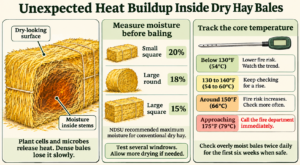
A moisture level which might be OK for a small square bale could increase hay bale heating in a larger package. North Dakota State University Extension provides the following maximum moisture guidelines for conventional dry hay at baling:
- Small square bales: 20% moisture.
- Large round bales: 18% moisture.
- Large square bales: 15% moisture.
These are extension recommendations rather than universal guarantees against heating. The risk will vary depending on forage type, bale density, weather and storage conditions. Other extension publications may well recommend more conservative figures, especially where fire risk is a concern.
The practical lesson is to adjust your moisture expectations according to the bale you’re producing rather than applying one moisture limit to every baler and every field.
What Internal Bale Temperatures Reveal
Hay bale heating can go unnoticed when a bale looks perfectly ordinary on the outside but is much hotter in the center. The most useful reading is therefore an internal reading taken with a suitable hay temperature probe rather than an assessment by touch.
University of Minnesota Extension identifies several temperatures that help put readings into context:
- Below 130°F (54°C): Lower fire risk, although a rising trend still deserves attention.
- 130–140°F (54–60°C): Heating is in progress. Keep an eye on whether the temperature stabilizes or drops.
- Approx. 150°F (66°C): Fire risk increases. More frequent checks and a safety assessment will be required.
- 175°F (79°C) and above: Serious danger. Alert the fire department and don’t move or ventilate the hay at all without their instructions.
These readings are not a countdown to ignition. The rate of temperature rise is just as important. A bale which is warming up rapidly can be far more of a concern than one which has reached its peak temperature and is now starting to fall.
Hay bale heating problems are very common in the first 6 weeks after baling. The Extension guidelines recommend checking bales that have been baled at excessive moisture twice a day during that period. The probes have to get down into the relevant internal zone and readings must be taken consistently so that any change is apparent.
Practical Ways to Prevent Excessive Heating
Preventing hay bale heating starts before the baler even gets to the field. Give your cut forage sufficient drying time and check the moisture rather than making a judgment on how dry it is by color, texture or how dry the windrow feels at the surface. Stems and dense sections can hold onto moisture even when the outer leaves are well dried.
Use a good hay moisture meter and take several samples around the field. The conditions can vary quite dramatically between windrows and throughout the day. Dew, humidity and changing weather can all result in a higher moisture reading even after the crop had looked ready earlier on.
Check the appropriate moisture recommendation for the intended bale format. If the readings are too high then further field drying is safer than assuming the bale will finish drying on storage.
Storage layout also influences hay bale heating. Appropriate storage facilities and good spacing (to allow for normal airflow around the bales) will help to minimize heat retention. Ventilation is a preventative measure though and not a solution for hay that is already dangerously hot. Adding airflow in the event of a suspected overheating emergency could actually feed a fire so must not be done.
Pay particular attention to the newly baled hay where the moisture readings were marginal (particularly the large, dense bales). Record temperatures and look for a downward trend rather than just accepting one acceptable reading as being sufficient to prove the risk has passed.
Warning Signs That Require a Safety Response
A musty or odd smell, visible vapor, discoloration or smoke can indicate hay bale heating. None of these are substitutes for temperature measurement and some of them only manifest themselves once the problem has actually got to a serious stage.
If the readings go up unexpectedly then reassess the situation immediately. At high temperatures, simply moving or breaking up the bales can introduce oxygen and cause a flare up. Don’t make your fire safety decisions on the basis of some general rule to “open the stack for airflow”.
If the temperature approaches 175°F (79°C) or if smoke or smoldering is suspected, then get the fire department on the phone immediately. Keep people away from the affected hay and just follow the professionals’ advice rather than trying to take the stack down.
There’s another hazard in that you can have concealed burned out cavities in very hot stacks. Don’t climb or walk over any stacks that you suspect may be in that condition. If it’s safe to do so and you need to do a routine check of your stacked hay, you’ll of course follow the extension guidelines on working with another person and using appropriate fall protection.
The Most Important Check Happens Before Storage
Hay bale heating is generally a moisture issue first, a temperature issue second. Large bales in particular need closer attention, as their compact mass can retain heat, though no bale type is immune. The sensible approach is to measure the moisture prior to baling, keep a close eye on the hay at risk during the early stages of storage and take any high readings very seriously indeed. That will go a long way to protecting both your stored forage and your farm buildings.