Yield Map Errors: Why Harvest Data Can Mislead You

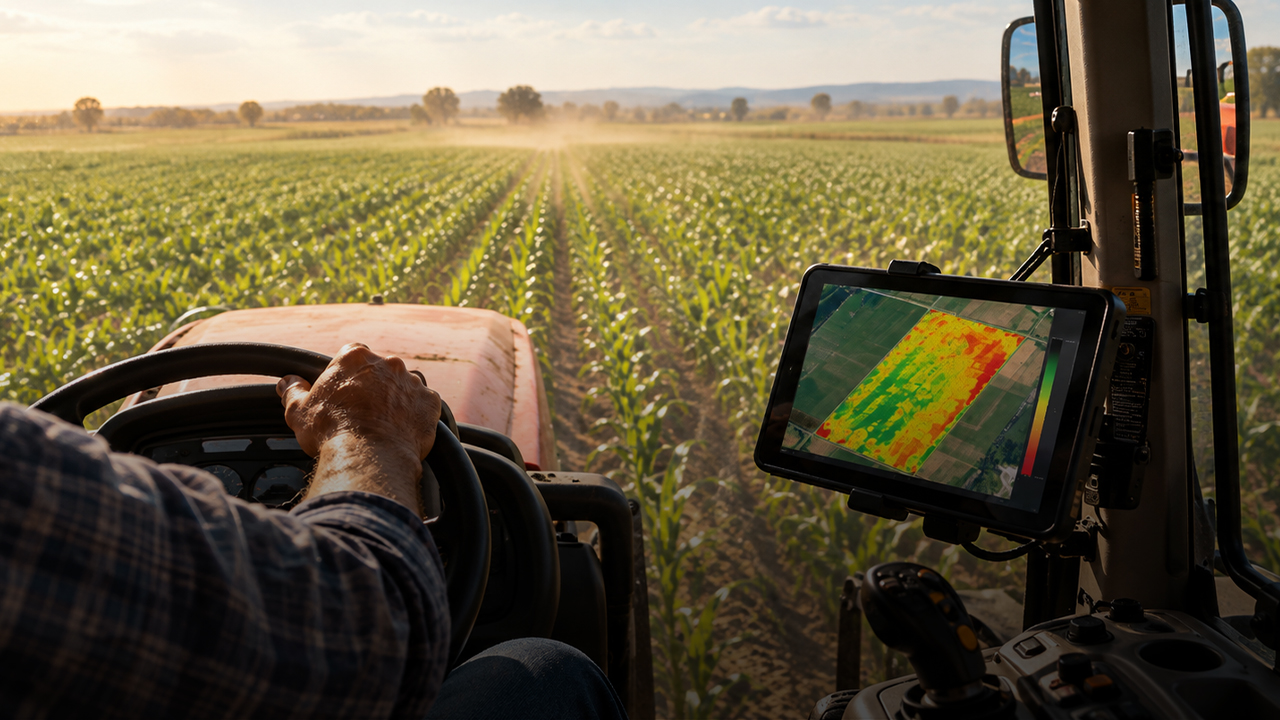
Yield map may make a field appear simple to interpret, with the different colored areas suggesting where the crop performed well and where its growth was weaker. However, the accuracy of the picture depends entirely on the measurements that underlie it, and errors in the yield map can occur long before the data gets onto the screen.
The combine takes measurements as it moves, and if the sensor is miscalibrated, if the settings are wrong, or if the reading is only slightly misplaced, this can affect what the map displays. In some cases, the yield figure itself is altered, while in others, the value stays the same but is assigned to the wrong location. Understanding this difference helps farmers examine suspicious patterns more carefully before making decisions based on them.
How a Combine Turns Grain Into a Map
A combine does not measure the yield for each individual patch of land. Rather, the monitor calculates the yield from the amount of grain passing through the machine, the speed at which the combine is moving, and the width of the strip it is cutting. The University of Florida Extension states that the calculation is obtained by dividing the flow rate by the speed and by the swath width, with the flow generally being recorded every one to two seconds. The moisture sensors adjust the result to a standard moisture level, and a satellite receiver (either GPS or GNSS) attaches a location to each reading. Although cotton pickers also use similar sensors, Florida points out that most of them do not have moisture sensors, which could introduce an error.
That chain has several links, and each one can slip:
- When the monitor is set to the incorrect cutting width, it will then calculate the wrong area.
- When the grain sensor is off, the amount of grain will be incorrect.
- The moisture-adjusted yield will be incorrect if the moisture is measured inaccurately.
- When a reading is assigned to the incorrect position, a reasonable number will appear where it doesn’t belong.
Sensor Readings and Calibration
On many combines, sensors estimate the flow of grain as it travels up the clean-grain elevator inside the machine. One common arrangement uses an impact plate that grain strikes as it moves through the machine. A sensor measures the force of the impact and uses it to estimate the grain’s flow rate. Optical sensors, on the other hand, measure the amount of light that the grain blocks, and Florida points out that their accuracy can be influenced by slope, moisture, vibration, and kernel type. Regardless of the method used, the sensor provides an estimate of the grain passing by; it does not weigh each portion.
Calibration is the process by which the monitor learns to convert those readings into pounds; it does this by comparing the monitor’s estimate with a known weight obtained from a scale. Mississippi State University Extension recommends using one to six calibration loads, with each load collected at a different grain-flow rate, and Florida recommends four or five loads for the purpose of constructing a calibration curve. In both cases it is advised to recalibrate if the conditions change; Mississippi State mentions large differences in moisture, a rain event, and changes in test weight, while Florida gives a change in moisture or hybrid as the criterion. Furthermore, Cornell states that the mass flow sensor should be checked and zeroed each morning.
Omitting this step may prove to be expensive. According to Mississippi State, a sample of combines in Mississippi in 2023 and 2024 showed calibration errors ranging from 6 to 58 percent. Moisture is also an important factor. Since most monitors accept only one moisture calibration point, Mississippi State recommends comparing the combine’s meter with a calibrated meter or the elevator’s certified one, and Cornell advises cleaning the moisture sensor lens and checking it for damage each day.
Calibration errors can distort yield measurements across much of the harvest, so even a map that appears smooth may contain consistently inaccurate figures.
Common Yield Map Errors During Harvest
Normal combine movements can also cause errors:
Reduced cutting width. When the combine cuts only part of its header width along the edge of a field, the monitor nevertheless assumes that the full width has been cut. Because the monitor calculates yield using an area larger than the one actually harvested, that section of the field appears to have produced less grain than it did. Mississippi State states that the yield should be considered underestimated in any case where the full header width isn’t harvested, and that if the actual width cannot be determined then the affected data should not be corrected and must be removed. Cornell’s recommendation is to ensure that the width that is recorded corresponds to the width that was actually harvested.
Changes in harvest speed. The speed of the machine can vary, and slowing down, accelerating, or braking abruptly affects the way the grain flows through it. Mississippi State states that rapid braking—for example, to avoid an obstacle or when the header is clogged—can cause yield spikes, while extremely low speeds or quick stops can result in a yield jump over a small area. Cornell advises maintaining a constant speed within the range for which the monitor was calibrated, as the data obtained outside of that range is less accurate.
Changes during pass starts, stops, and turns. When a pass begins and ends, the grain flow increases and then decreases, and Cornell states that short passes cause distortion for this reason. Mississippi State also says that very low yields are recorded if the header is down but not cutting, or if the header sensor is off, especially along the field edges during turns.
Timing and position. It takes the grain several seconds to get from the cutting header to the sensor, so the monitor has to adjust each reading to reflect where the grain was actually cut. Mississippi State points out that a default correction of 12 seconds might not be appropriate for all combines, and an incorrect delay can produce a wave-like pattern across field features such as waterways. Purdue’s Bob Nielsen identifies grain-flow lag and an incorrectly accounted-for GPS offset, the distance between the antenna and the header, as possible causes of misplaced yield readings. Position accuracy is also important: Florida states that a GNSS receiver lacking a differential correction signal is accurate only to about 10 meters.
One Corn Harvest, Several Possible Errors
Suppose that corn is being harvested with a combine near an irregular field boundary. In order to follow the edge, the operator reduces speed and the header then cuts only a few rows rather than its full width. The monitor, however, still has the full-width setting, which causes the calculated yield for that strip to be unusually low.
At the same time, grain from the final section is still being sent to the sensor. If the delay setting is incorrect, the reading obtained then might be assigned to a later position. Almost at the end of the pass, a sudden change in speed could cause an odd spike.
The final map might show a low-yield strip alongside an irregular patch of unusually high yield. This does not necessarily mean that there is a problem with the soil or the crop. It might instead be due to various measurement and timing issues during the same short pass.
To What Extent Is the Data Affected?
Mistakes of this kind are common. Mississippi State has referred to studies which show that between 13 and 27 percent of yield data contain errors that should be eliminated during post-processing. A study published in Agronomy Journal examined four maize and soybean yield maps and found that eliminating the bad data points removed 13 to 20 percent of the original data; Of the data points removed, 72 to 85 percent were identified during the first two screening stages, which focused on header status and delays at the beginning and end of each pass. Further cleaning of the remaining data improved map precision by an additional 4.3 to 5.4 percent. Nielsen from Purdue says that even a calibrated and well-operated monitor almost always generates data that require cleaning.
Reducing Yield Map Errors Without Overcomplicating Harvest
Basic checks prevent many avoidable problems:
- Calibrate the yield monitor using grain loads weighed on a scale at different flow rates, and recalibrate whenever the crop, hybrid, or moisture conditions change.
- Each morning check and zero the flow sensor and also clean the moisture sensor.
- Make sure that the recorded cutting width matches the width that is being cut.
- Maintain speeds within the calibration range.
- Make sure that the monitor records the start and stop of each pass.
- Cornell recommends backing up the raw files during the season rather than keeping them on the monitor or in the cloud.
Even with all these checks, some problems may still go unnoticed. To see where abnormalities take place and how widespread they are, Nielsen recommends mapping the swath width, harvest speed, and GPS signal quality alongside yield after harvesting. The cleaning process then involves correcting delays and offsets, adjusting the swath widths, and removing unreliable data points from the beginning and end of passes, during sudden speed changes, and when the header is lowered without actively cutting the crop. Mississippi State mentions software like the USDA’s Yield Editor as being used for this task and points out that no one protocol works for all data sets, so judgment is still important.
You can help tell the difference between actual yield differences and errors in recording by comparing the map with your observations in the field and with the results from previous seasons.
Looking Beyond the Yield Map
Yield maps provide a useful record of field performance, but they cannot capture crop conditions perfectly. Their reliability depends on the measurements recorded and the settings used during harvest, often as conditions are changing. When you know where errors occur, it becomes easier to interpret an odd pattern and decide which areas should be examined more closely before altering the way the field is managed.