

Hydraulic Valves for Laser Land Leveling Explained


Keeping the scraper blade at the correct height as the tractor goes over uneven ground is a constant exercise. As the tractor goes up and down with the ground, the operator may need to repeatedly adjust the implement to prevent it from cutting too deeply or leaving high spots. That is very difficult to maintain over a long pass.
Hydraulic valves for laser land leveling help automate those repeated blade corrections. The laser provides the reference, the electronics work out whether the blade needs to move and the hydraulics do the moving. That’s what automation’s for and that’s why setup is so critical.
How the Laser System Decides When the Blade Must Move
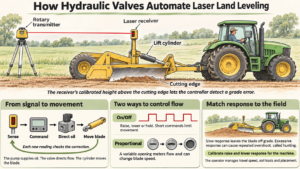
A rotary laser transmitter is set up near the field to establish a reference plane. Some will give you a horizontal plane, others can be set up to give you a plane at a specified slope (depending on the required field slope).
A receiver mounted on a mast above the scraper picks up where the rotating laser beam hits its sensing area. It makes no measurement of the blade edge at all. The control system uses the position of the receiver on the mast and the overall setup of the system in relation to the blade to determine whether the blade edge is above or below grade.
The receiver will pass that data on to an ECU (electronic control unit), which is typically mounted where the operator can monitor it. If a correction is required as a result of the position being measured then the controller will send an electrical output to an appropriate hydraulic valve. The process then simply continues as further readings come in.
This feedback loop picks up an error, issues a command to correct it and then checks the result. The laser and receiver provide the positional information but neither of them in any way provides the force required to lift a loaded scraper.
How Hydraulic Valves for Laser Land Leveling Move the Blade
The tractor hydraulic pump supplies the pressurized oil. The hydraulic hoses then carry that oil via the appropriate control circuit to the valve and cylinder, with a return path that allows oil to flow back through the system. The valve directs the oil, and the cylinder in turn converts hydraulic pressure and flow into mechanical movement.
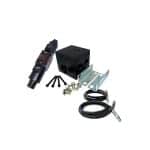
In many directional valves, a movable spool will change which of the internal passages are in communication. An electrical actuator (a solenoid) will move or control the valve in accordance with the controller’s command and the valve will then direct the oil to produce the required cylinder movement to move the scraper with respect to the ground.
Oil flow is of course absolutely critical to the speed at which a cylinder will move. Pressure is related to the force the cylinder can develop. Both pressure and flow depend on the load, the cylinder design and the circuit so valve selection is not simply a matter of the electrical connection.
Not all scrapers are lowered the same way. In a double acting cylinder arrangement hydraulic pressure can be used to move the scraper in both directions. In a single acting arrangement hydraulic pressure may lift the scraper and its own weight will then assist in the lowering. The actual physical movement is very different.
On/Off Versus Proportional Valves: What the Blade Does Differently
An on/off directional valve will switch between defined states when the solenoids are commanded. In a normal lift control situation the controller will command the blade to raise or lower (or indeed make no correction at all). The actual movement of the blade will be a function of the available flow, the circuit and how long the valve is held in the commanded position. Electronic controls may well use a short command (or a series of short commands) to limit the size of the correction.
A proportional valve can vary its degree of opening in response to a changing electrical command. The controller can therefore ask for more or less flow and (where the hydraulic circuit allows) can vary the speed of the cylinder. A small correction can be made more gently whereas a larger correction may well require a faster response.
Proportional control does give you a massive amount of flexibility in the way you can command the movement. It in no way automatically gives you a smoother surface or better grading accuracy. The end result is very much a function of the controller, the hydraulics, the setup, the tractor speed and the soil. A good on/off system can be absolutely perfectly adequate for a lot of the grading you’ll be doing.
What Happens During a Pass Over an Uneven Field?
Imagine a tractor pulling a laser-controlled scraper across the field as it’s being prepared for irrigation. The operator has established the required field grade and has the receiver set in relation to the cutting edge prior to starting.
As the tractor goes over different ground, the scraper height relative to the laser reference may drift. The receiver will pick that up and the controller will then issue a raise or lower command. Oil goes through the hydraulic valve, the cylinder moves and the blade approaches the required position. The next reading will then allow the controller to either stop the command or modify it.
Where the field is high in relation to the planned grade, the scraper can cut and collect the soil, and the operator will be moving it into the lower areas. Auto blade height control will assist in maintaining the reference during that process but in no way dictates the overall soil movement plan or tells you when the scraper is to be emptied.
This is the crucial point: the machine can be set to make the blade corrections automatically while the operator is still in full control of the tractor, the soil load, the travel path and the entire field operation.
Why Hydraulic Response and Calibration Matter
A command won’t get the blade moving instantaneously. The valve has to act, the hydraulic oil has to move and the cylinder and implement have to do the work against the load. If the response is too slow in relation to the speed of the tractor you can end up with the blade staying away from grade as you go forward.
Too aggressive a control will lead to a completely different problem in that the blade can overshoot its intended position and then a correction in the other direction is made. Repeated over-correction is what we call “hunting” and that can lead to a lot of unproductive blade movement rather than the stable tracking of the laser reference that you’d ideally like to see.
Calibration is all about matching the electrical command to the actual machine response. In some systems this is achieved via receiver setup and separate raise and lower response settings. The way the machine will respond will be a function of blade weight, oil flow, valve action and travel speed. The adjustments should be made in accordance with the equipment specific instructions rather than some generic set of settings.
What Automation Cannot Correct on Its Own
The whole chain is predicated on good input and good hydraulics. A blocked laser beam, incorrect transmitter setup or incorrect receiver position can all lead to loss of position data or receipt of bad position data. A bad electrical connection, dirty hydraulic oil, insufficient hydraulic supply or an incompatible valve can all result in a valid controller command not producing any reliable blade movement at all.
Field conditions have an effect as well. Wet soil may stick in the scraper, compacted ground may be difficult to cut and a heavily loaded implement may respond differently from an empty one. Obviously if you’re driving faster than the blade can react then you can undermine an otherwise functioning control system.
The operator is still ultimately responsible for safe machine operation and will need to be watching the graded surface, watching the soil being moved and be ready to step in at any time when the auto control is not appropriate. Automatic leveling in no way takes the place of planning, equipment checks or judgement.
Conclusion
Hydraulic valves for laser land leveling convert the controller’s laser-guided commands into blade movement. The receiver will establish the position relative to a reference plane, the controller will then request a correction and the hydraulic system of the tractor will move the blade via the valve and cylinder. On/Off and proportional valves achieve the required movement in different ways but both require compatible equipment and appropriate response settings. This reduces the need for the operator to be constantly making manual blade adjustments, with the operator still having the overall decision.