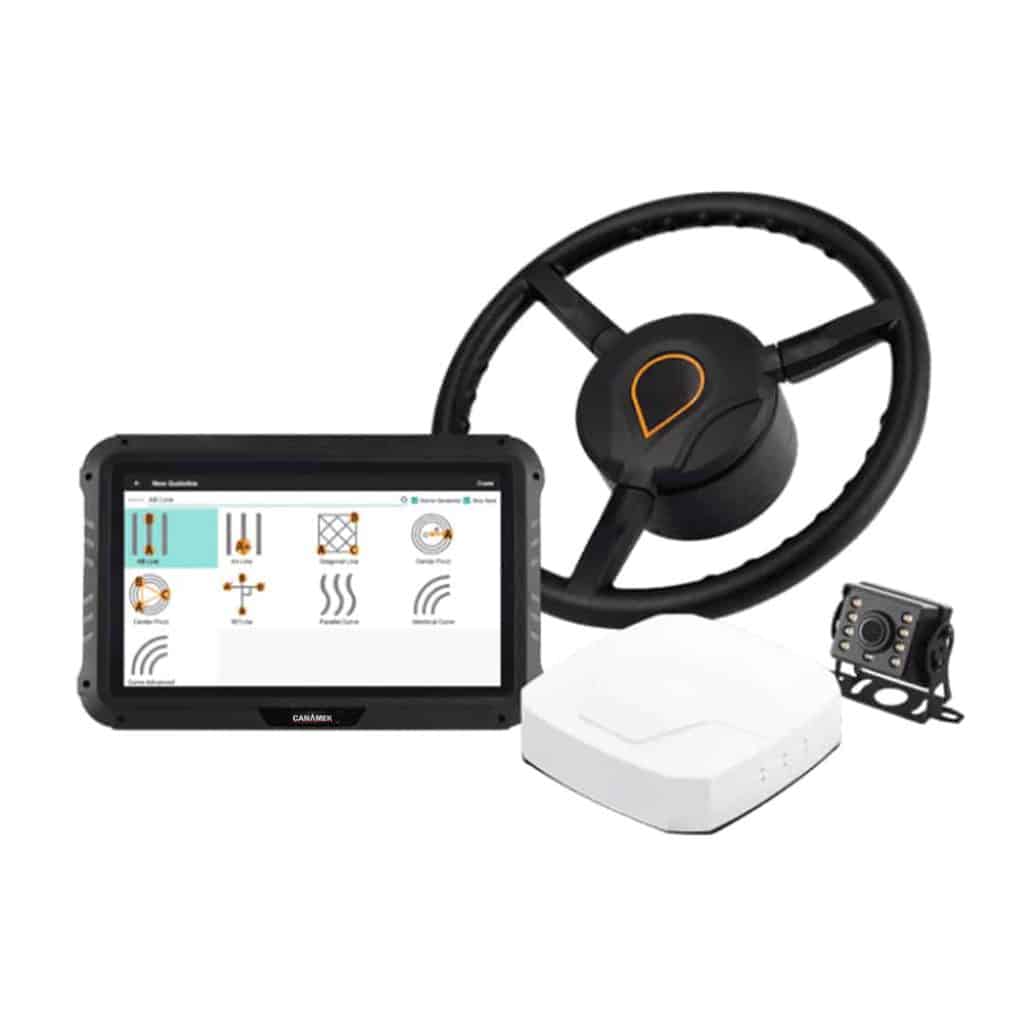
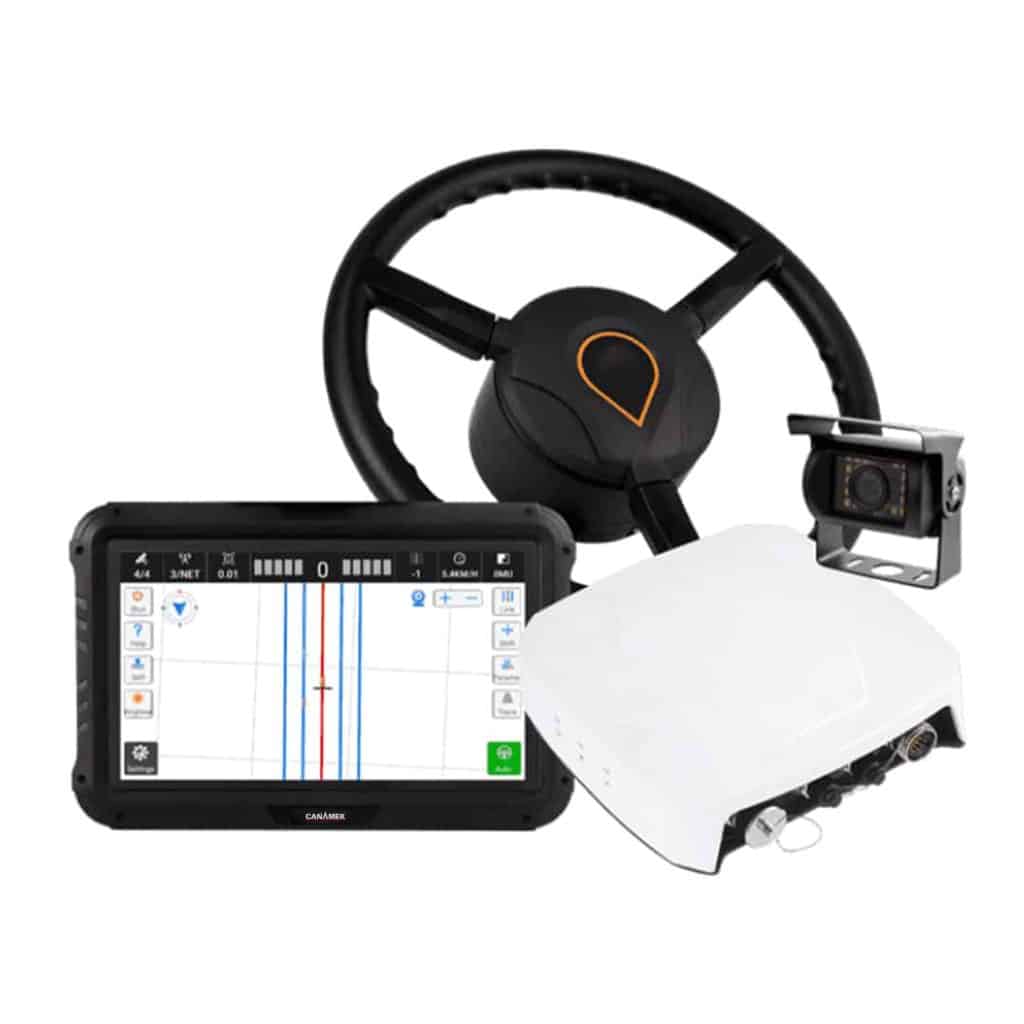
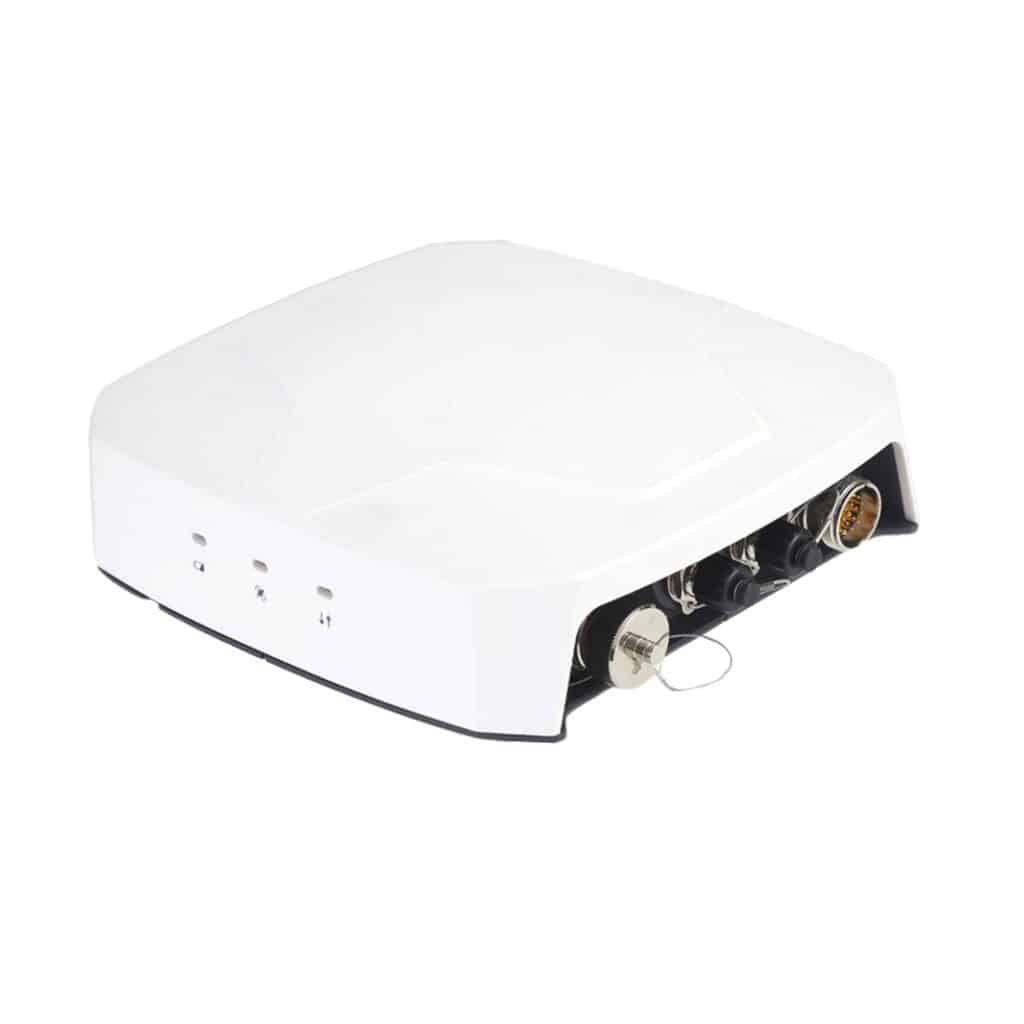
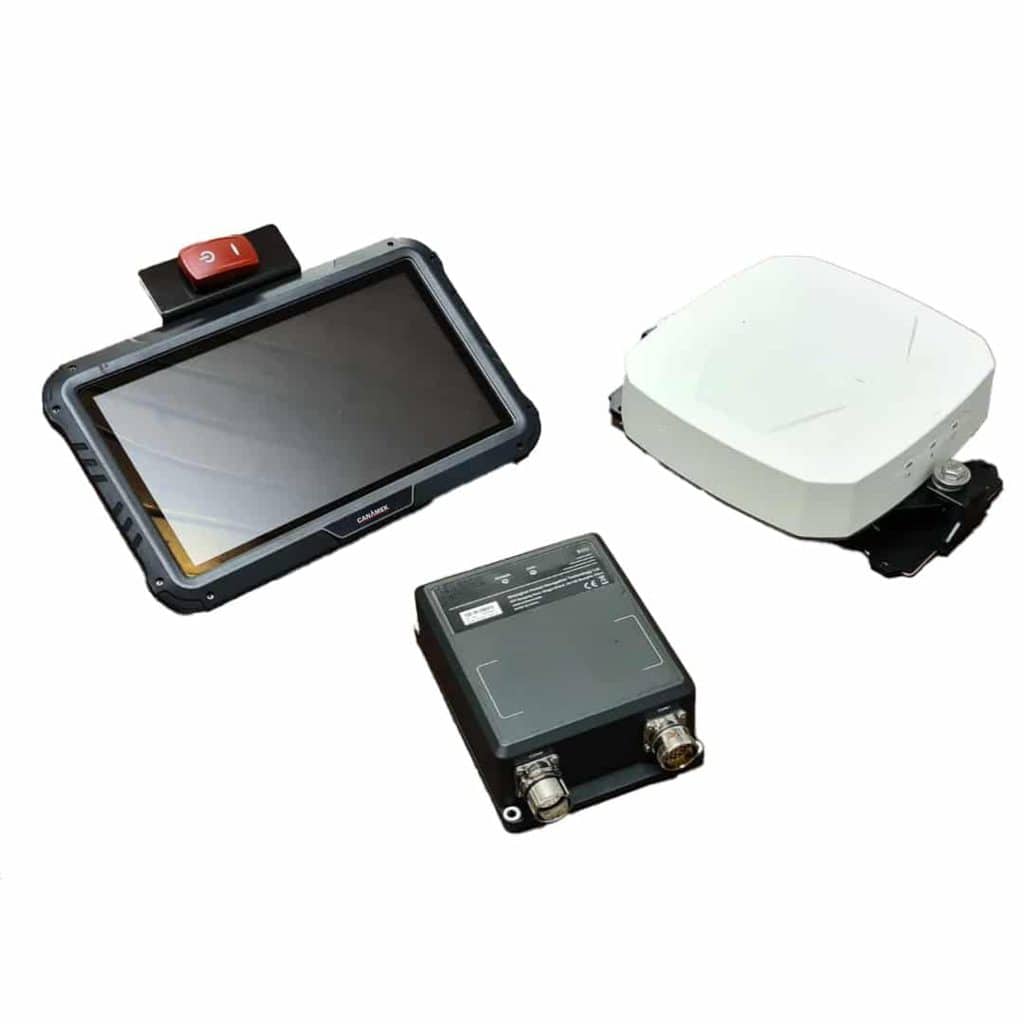
El CANAMEK X51 — GPS Auto Steering System for Tractors is a tractor autosteer kit for agricultural field operations, including soil preparation, seeding, planting, spraying, fertilizer application and harvesting. It uses GNSS positioning and terrain compensation to guide a compatible vehicle along a selected working route, with setup and monitoring handled through AgNav software on a 10.1 in / 256.5 mm industrial touchscreen.
The CANAMEK product page offers two configurations. The X51 Automated Steering System, based on the CHCNAV NX510 SE, uses an electric steering wheel to make guidance corrections. The X51 Steer Ready Automated Steering System, based on the NX510 Steer Ready platform, connects to a compatible tractor’s existing steering valve through its OEM steering interface.
Both configurations address the same field task: maintaining the tractor’s route while the operator supervises the machine and implement. The choice depends on the tractor’s steering equipment and installation requirements. RTK network and UHF base-station connectivity provide correction options, while the guidance software supports straight, curved and other field patterns suited to different operations.
X51 brings vehicle configuration, field setup, automatic steering and operating records into one guidance workflow.
The operator remains responsible for the vehicle, implement and surrounding conditions. Accurate machine dimensions, suitable corrections and correct calibration are part of obtaining the intended guidance performance.
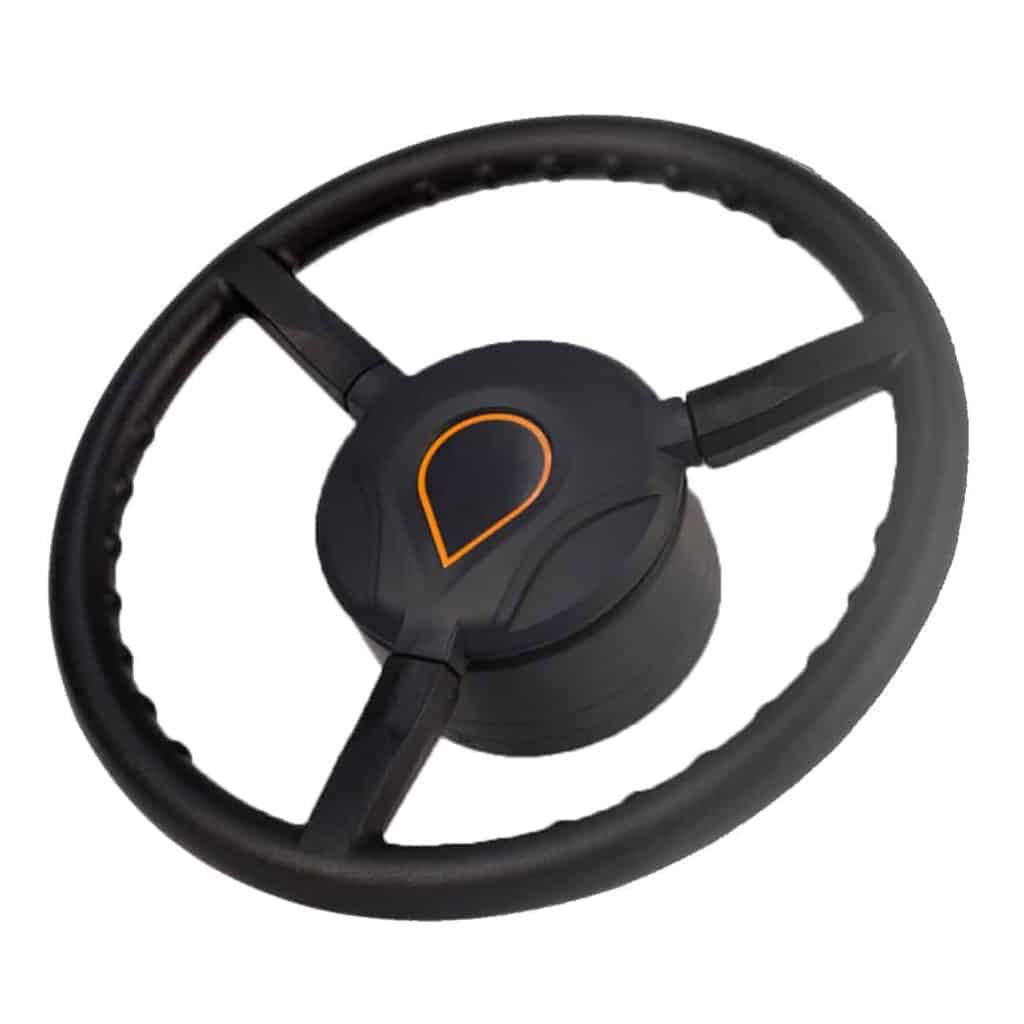
The electric configuration uses the NX510 SE platform and a CES-T electric steering wheel. The motor turns the steering wheel in response to guidance commands, providing a retrofit route for compatible new and existing tractors.
CANAMEK identifies the industrial display, UHF radio, motor drive and AgNav software as its principal package components. The manufacturer’s NX510 manual also documents the GNSS receiver, wheel-angle sensor, rear camera, mounting components and wiring used in the standard electric installation.
This configuration suits a compatible tractor being equipped through an electric steering-wheel installation. The correct steering-shaft fit, brackets and calibration must be established for the specific vehicle.
The Steer Ready configuration uses the tractor’s existing compatible steering valve. Its PLC ECU communicates through PWM or CANBUS, according to the tractor’s OEM steering arrangement.
The CANAMEK listing identifies AgNav software, the PLC ECU, the 10.1 in / 256.5 mm tablet, a rear camera and the receiver as the principal components. A compatible installation uses the tractor’s existing steering hardware without adding an electric steering wheel or a separate steering valve.
Select this configuration only after the tractor’s steer-ready interface and required harness have been checked. Having hydraulic steering alone does not establish that a tractor has a compatible OEM automatic-steering interface.
| Purchase consideration | X51 Automated Steering System | X51 Steer Ready Automated Steering System |
|---|---|---|
| Manufacturer platform | CHCNAV NX510 SE | CHCNAV NX510 Steer Ready |
| Steering method | CES-T electric steering wheel | Control of the tractor’s existing OEM steering valve |
| Main steering hardware | Electric motor and steering wheel assembly | PLC ECU and vehicle-specific connection |
| Key compatibility check | Steering-shaft fit, mounting and mechanical steering condition | Supported OEM steer-ready interface and PWM/CANBUS integration |
| Operator interface | 10.1 in / 256.5 mm touchscreen with AgNav | 10.1 in / 256.5 mm touchscreen with AgNav |
| Correction connections | Compatible network RTK or UHF base station | Compatible network RTK or UHF base station |
| Installation focus | Wheel replacement, motor mounting and calibration | Connection to the existing steering-control system and required setup |
The built-in correction radio is a receiver for compatible correction transmissions. A complete working installation also needs the selected correction source: a suitable network RTK service or a compatible GNSS base station.
Specify correction access, cellular data, installation hardware and software activations in the quotation. The manufacturer manual identifies ISOBUS UT as requiring additional activation. Other implement-control functions depend on the selected configuration, software and compatible equipment. A radio module in the kit does not establish that a base station or correction subscription is included.
The NX510 platform supports GPS, GLONASS, Galileo, BeiDou and QZSS, with SBAS signal support listed in the component datasheets. GNSS positioning is combined with inertial information to compensate for changes in vehicle attitude as the tractor moves across the field.
This terrain compensation supports guidance where the machine encounters uneven ground. The Steer Ready documentation specifies six-axis terrain compensation; the NX510 SE documentation describes its GNSS+INS approach. In both cases, accurate installation measurements and calibration remain essential.
CHCNAV specifies pass-to-pass steering accuracy within ±0.98 in / ±2.5 cm. This is a guidance-performance figure, distinct from the receiver’s horizontal and vertical RTK positioning specifications. It should be used with an appropriate correction solution and should not be extended to every positioning mode or treated as a guarantee of a trailing implement’s exact position.
In the electric configuration, the CES-T motor provides 5.53 lb-ft / 7.5 N·m rated torque. The steering wheel measures 16.14 in / 410 mm in diameter, and the motor height is 3.17 in / 80.5 mm.
The receiver and guidance software determine the required steering response, and the motor makes the wheel adjustment. AgNav supports vehicle-specific calibration, including steering controller and wheel-angle sensor settings. The documented installation supports a GASensor arrangement as well as other supported sensor modes where applicable.
This provides automatic route following on a compatible tractor fitted with the electric kit. The final result also depends on the condition of the tractor’s steering mechanism; worn components or excessive steering play require attention during installation.
The Steer Ready option sends steering commands through the PLC ECU to a compatible OEM steering valve. PWM and CANBUS support allow the installation to match different supported tractor interfaces.
This configuration retains the tractor’s existing steering wheel and uses its factory steering-control hardware. The vehicle-specific interface, cable connections and software settings must be correct for the tractor model. The kit is therefore selected by verified steer-ready compatibility, rather than tractor size or brand alone.
For an owner of a compatible machine, this offers a route to GNSS guidance that uses the steering equipment already installed on the tractor.
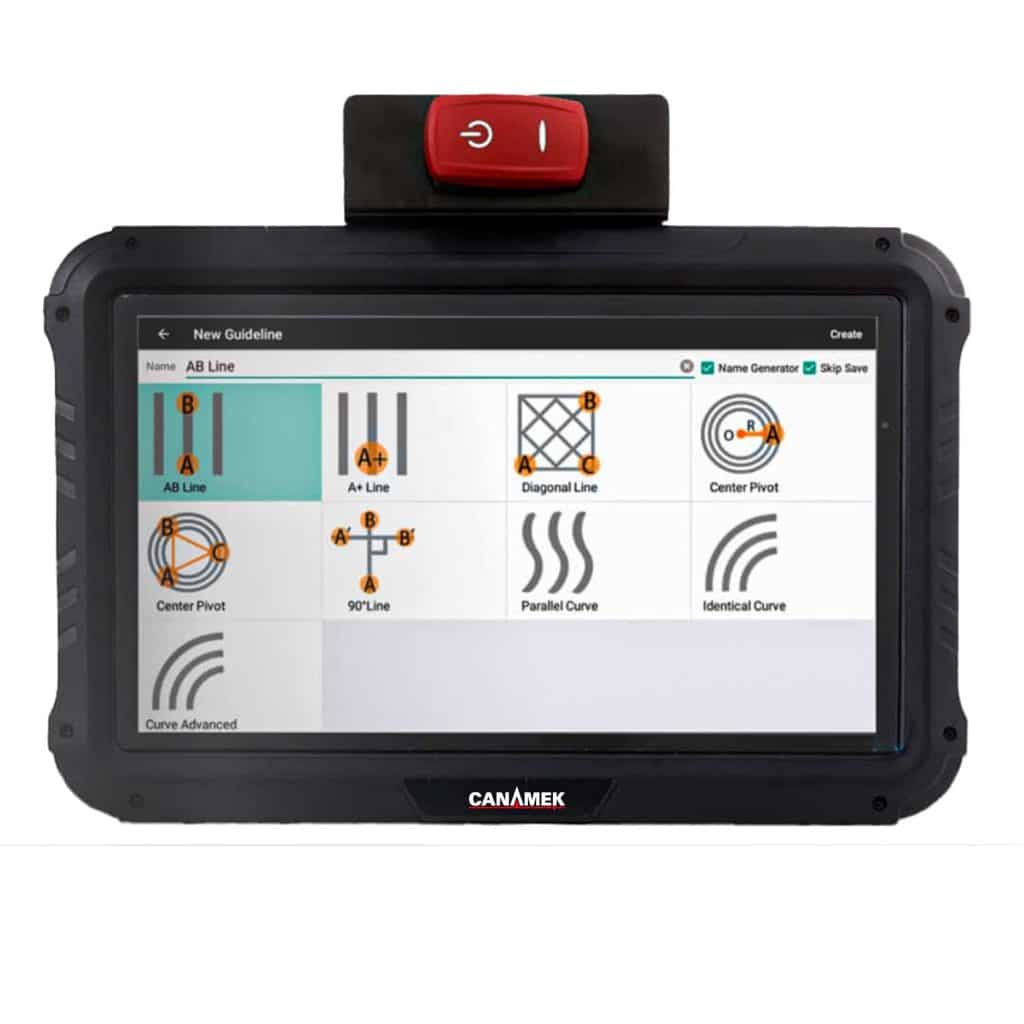
AgNav supports guidance patterns for different field layouts. The NX510 SE documentation lists AB line, A+ line, circle line, irregular curve and headland-turn operation. The Steer Ready documentation lists AB line, A+ line, pivot, curve, 90° line and headland line.
The NX510 software manual further documents parallel, identical and free-curve creation, path lines and harrowing patterns. Available functions must correspond to the installed software and selected configuration.
Operators can establish field boundaries, create guidance lines and configure implement width and offsets. Saved field and guideline data support repeated use of an established working layout, while curve and pivot patterns provide alternatives where straight passes do not suit the operation.
The documented NX510 software includes headland-turn functions, with “Bulb” and “Fish tail” U-turn modes in the referenced AgNav manual. Bulb U-turn settings include row skipping, turn direction and an automatic trigger based on distance to the AB point.
These controls allow a suitable turn sequence to be configured around the vehicle and field. Actual use depends on the installed software, machine compatibility and available space for the tractor and implement.
AgNav also includes automatic-steering engagement settings and manual override. The operator can supervise guidance and regain control when the operation requires it.
The CB-H10 terminal combines a pantalla táctil capacitiva de 10.1 in / 256.5 mm with multilingual AgNav software. Its documented screen resolution is 1024 × 600 pixels, with brightness of approximately 218.9 fL / 750 nits.
The display is used to configure the machine, select guidelines, review correction status and monitor the current task. Its IP65 housing is intended for the working environment of an agricultural cab.
The documented rear camera provides 1280 × 720-pixel resolution and a 120° field of view. It allows the operator to view the configured rear or implement area from the terminal. Camera image resolution and tablet screen resolution are separate specifications.
Keeping successive passes aligned by hand requires continuous attention to the steering wheel. X51 uses its selected guideline and positioning solution to make routine steering adjustments through the electric motor or the OEM steering interface.
This can help reduce repetitive steering effort during long field operations and allow the operator to devote more attention to implement performance and task status. It remains a supervised guidance system.
Unnecessary overlap and missed strips can occur when pass spacing varies. Configuring the implement width and offsets gives AgNav the information needed to lay out the intended working passes, while automatic steering follows the selected route.
This can support more consistent coverage during tillage, planting, spraying and spreading. Correction quality, calibration, implement movement and field conditions affect the result. Guidance alone does not determine seed placement, chemical rate or implement working depth.
The platform provides built-in 4G and UHF correction connectivity. Network RTK is configured through the supported CORS/NTRIP workflow, while the UHF receiver supports compatible base-station transmissions in the 410–470 MHz band.
The datasheets list RTCM 3.0, 3.1, 3.2 and 3.3 correction formats. Radio frequency, protocol and network access must match the correction source in use. AgNav displays positioning information so the operator can check the solution before starting precision work.
CHCNAV’s current NX510 SE page lists SPP, DGPS, RTK, E-PPP, H-PPP and DRSmooth. It identifies H-PPP with Galileo E6-HAS and describes automatic switching between RTK and PPP.
These modes provide alternative positioning arrangements, with different accuracy characteristics, coverage and convergence requirements. Some functions depend on the receiver version. They should be selected for the task and available service; the RTK pass-to-pass figure is not a blanket accuracy claim for every mode.
AgNav manages vehicle settings, implement parameters, farms, fields, boundaries, guidelines and tasks. The NX510 manual documents SHP data exchange for guidelines and field information, CHC XML and supported Topcon guideline imports, and ISOXML farm import.
Guidelines can be transferred through supported share-code workflows. Task records can be exported as CSV files. These functions help retain working layouts and operating records between jobs, subject to the installed software’s format support.
The NX510 SE documentation establishes ISOBUS compatibility, and the NX510 manual specifically identifies UT operation with additional activation. The current Steer Ready page lists BAS, GEO, VT and TC-SC functions for compatible implements.
The available functions must be matched to the chosen configuration and implement. A terminal with ISOBUS support does not automatically equip every attached implement for section or variable-rate control. Specify the required function, implement compatibility and activation before purchase.
The system provides CAN, RS232, Wi-Fi and Bluetooth connections. NMEA output rates of 1, 2, 5 and 10 Hz are listed in the datasheets. Steer Ready documentation also identifies 5 V pulse output for supported third-party integration.
Connections to other equipment require a compatible interface and the correct wiring. Where a speed-pulse conversion module is required, it must be included in the chosen integration; it is not established as a standard package component.
AgNav includes remote assistance through an identification code and diagnostic log upload. The NX510 manual also documents software and firmware maintenance procedures, with support depending on the installed component version.
CANAMEK provides After-Sales Support, 7 Days a Week. Use CANAMEK Support & Service for assistance with the supplied equipment and configuration.
X51 supports the vehicle-guidance part of field preparation, ridging, seeding, planting, spraying, fertilizing, spreading, ditching and harvesting. The required steering configuration depends on the tractor, while the guideline and implement settings depend on the operation.
An electric steering installation may suit an existing tractor being retrofitted with guidance. A supported steer-ready tractor can use the OEM-interface configuration. Agricultural contractors can retain compatible vehicle and field configurations when moving between jobs, with the necessary installation hardware and calibration for each machine.
The X51 offering provides two documented steering configurations under one CANAMEK product page, allowing the installation to be selected around the machine already in use. Both combine a guidance terminal, GNSS positioning and AgNav software with the required steering-control arrangement.
The CANAMEK offering includes a 2-Year Free Warranty y After-Sales Support, 7 Days a Week. Request a configuration that identifies the steering hardware, vehicle-specific cables, correction access and activated functions. Software ownership and service charges should be stated in the quotation; no lifetime or subscription-free entitlement is implied by the hardware specification.
The X51 provides a choice of steering hardware around a common agricultural guidance workflow. The electric version adds motor-driven wheel control to a compatible tractor, while Steer Ready uses a supported OEM steering interface. GNSS positioning, terrain compensation and AgNav give both configurations the information and controls needed to follow planned field routes.
For growers, this offers a practical way to add automatic guidance to an appropriate machine. For agricultural contractors, the configurable vehicle, implement and field records support different jobs and compatible equipment.
Buyers considering a larger terminal can also review the CANAMEK X61 GPS Auto Steering System, which uses the NX612 platform and a 12.1 in / 307.3 mm display. Compare the installation and functions required for the tractor through the CANAMEK auto steering range, or contact CANAMEK with the make, model and implement details.
The CANAMEK X51 is a GNSS automatic-steering system for compatible agricultural vehicles. It combines positioning, terrain compensation, an industrial touchscreen and AgNav software. The CANAMEK page offers an NX510 SE-based electric steering configuration and an NX510 Steer Ready configuration for compatible OEM steering interfaces.
The electric version uses a CES-T motor and steering wheel to make steering corrections. Steer Ready uses a PLC ECU to control the tractor’s existing compatible OEM steering valve through PWM or CANBUS. The correct choice depends on the tractor’s steering equipment and verified installation compatibility.
Choose the electric kit for a supported electric steering-wheel retrofit, or Steer Ready when the tractor has a compatible OEM automatic-steering interface. Provide the tractor make, model and steering details so the required hardware, connections and calibration can be checked before purchase.
CANAMEK identifies the display, UHF radio, motor drive and AgNav software as the principal components. The manufacturer’s standard NX510 electric-package list also includes a PA-3-family receiver, CB-H10 tablet, CES-T steering wheel, GASensor, rear camera, mounting components, system and accessory cables, and a radio antenna. The order specification identifies the actual receiver variant and vehicle-specific installation hardware.
The CANAMEK listing identifies AgNav software, a PLC ECU, a 10.1 in / 256.5 mm display tablet, a rear camera and a receiver. The installation connects to a supported tractor’s existing steering system using the appropriate vehicle-specific interface and wiring.
No. It requires a supported OEM steer-ready or auto-guidance-ready interface. Hydraulic steering by itself does not establish compatibility. The tractor’s steering valve, control protocol and required harness must be checked for the specific model.
A supported Steer Ready installation uses the tractor’s existing steering wheel and OEM steering valve. It does not require the additional electric steering wheel used by the electric kit or a separate replacement steering valve.
Yes, the NX510 SE electric platform supports retrofit installation on compatible existing tractors. Steering-shaft fit, brackets, electrical supply and mechanical steering condition must be suitable. Installation and calibration must be completed for the actual vehicle.
CHCNAV specifies pass-to-pass steering accuracy within ±0.98 in / ±2.5 cm with suitable corrections and setup. This is separate from the receiver’s RTK positioning accuracy. Correction status, calibration, machine condition and implement behavior affect the practical result.
The platform combines GNSS positioning with inertial information to account for changes in the vehicle’s attitude as it moves across the field. This supports route following over changing terrain. The machine dimensions, sensor installation and calibration must be correct.
The NX510 SE documentation lists AB line, A+ line, circle line, irregular curve and headland-turn operation. Steer Ready documentation lists AB line, A+ line, pivot, curve, 90° line and headland line. The NX510 manual documents additional curve and path functions; availability depends on the installed software and configuration.
The NX510 documentation supports headland-turn functions. The referenced AgNav manual describes Bulb and Fish tail U-turn modes, including row-skipping and automatic-trigger settings for Bulb turns. The installed software, tractor configuration and available turning space must support the selected operation.
No. X51 is used for supervised agricultural guidance. The operator remains responsible for the vehicle, implement and surrounding conditions. AgNav includes steering engagement settings and manual override controls.
CHCNAV’s current NX510 SE page states a maximum working speed of 18.64 mph / 30 km/h. Its current Steer Ready page lists 0.06–18.64 mph / 0.1–30 km/h. The actual working range depends on the tractor, implement, software settings and installed configuration.
Not necessarily. The platform supports compatible network RTK corrections as well as correction reception from a local UHF base station. Network access requires an appropriate service and data connection. A compatible correction source must be selected for precision operation.
The supplied CANAMEK component lists do not establish that either is included. The UHF radio is a correction receiver, not a base station. Ask for the order specification to identify any base station, network correction access or cellular service supplied with the selected configuration.
The current manufacturer page lists SPP, DGPS, RTK, E-PPP, H-PPP and DRSmooth. H-PPP is identified with Galileo E6-HAS. Mode availability and performance depend on receiver version, service coverage and operating conditions; the RTK steering figure should not be applied to every mode.
A suitable UHF base-station connection can supply corrections without cellular network RTK. Other supported positioning modes have their own requirements. Network RTK, remote assistance and online functions require the appropriate connection for the selected service.
Yes, with the appropriate configuration and compatible equipment. NX510 SE documentation identifies ISOBUS compatibility, and the NX510 manual states that UT requires additional activation. The current Steer Ready page lists BAS, GEO, VT and TC-SC functions. The required implement function and activation should be specified when ordering.
The NX510 manual documents SHP guideline and field-data exchange, CHC XML and supported Topcon guideline imports, ISOXML farm import, and CSV task export. Supported share-code transfers are also available. File compatibility must match the installed software and the type of data being transferred.
The CB-H10 tablet has a 10.1 in / 256.5 mm touchscreen with 1024 × 600-pixel resolution. The rear camera is specified at 1280 × 720 pixels with a 120° field of view. The screen and camera resolution figures describe different components.
CANAMEK lists a 9–32 V DC system supply. The NX510 hardware manual also specifies 9–32 V DC for the CES-T electric steering motor, while the receiver and tablet have individual 9–36 V DC ratings. Follow the supplied installation instructions and component labels; the higher rating of an individual component does not establish the limit for the complete installation.
No. The GNSS receiver is rated IP67, while the CB-H10 display and CES-T electric steering assembly are rated IP65. The documented GASensor is IP67. Ratings apply to the named component and should not be combined into a blanket system rating.
CHCNAV describes transfer between compatible vehicles. Each tractor still needs the correct mounting or OEM-interface hardware, electrical connections and configuration. The necessary calibration and steering compatibility must be checked for each machine.
The supplied documentation does not establish a lifetime, subscription-free entitlement for every function or service. ISOBUS UT requires additional activation, and correction or cellular services have their own arrangements. The quotation should state the included activations and any ongoing service charges.
X51 uses the NX510 SE or NX510 Steer Ready platform and a 10.1 in / 256.5 mm display. CANAMEK X61 uses the NX612 platform and a 12.1 in / 307.3 mm display. Their steering hardware, software options and component specifications must be compared for the intended tractor; features should not be assumed interchangeable.
CANAMEK provides a 2-Year Free Warranty and After-Sales Support, 7 Days a Week for this offering. AgNav also includes documented remote-assistance and diagnostic-log functions for support through a suitable connection.
| Elegir | X51 Automated Steering System | X51 Steer Ready Automated Steering System |
| Especificación | Valor |
|---|---|
| Product name | CANAMEK X51 — GPS Auto Steering System for Tractors |
| CANAMEK SKU | CNMK-ASS-1019 |
| Electric configuration | X51 Automated Steering System; CHCNAV NX510 SE platform |
| OEM-interface configuration | X51 Steer Ready Automated Steering System; CHCNAV NX510 Steer Ready platform |
| Electric steering method | CES-T electric steering wheel |
| Steer Ready steering method | PLC ECU controlling the compatible OEM steering valve through PWM or CANBUS |
| Guidance control | Integrated |
| Operator software | CHCNAV AgNav; detailed software functions referenced from the NX510 AgNav 3.0 manual |
| Display size | 10.1 in / 256.5 mm |
| Terrain compensation, electric version | GNSS+INS |
| Terrain compensation, Steer Ready | Six-axis compensation with integrated inertial sensing |
| NX510 SE maximum working speed on current manufacturer page | Up to 18.64 mph / 30 km/h; vehicle and software limits apply |
| Steer Ready operating range on current manufacturer page | 0.06–18.64 mph / 0.1–30 km/h; vehicle and software limits apply |
| CANAMEK-listed system external supply | 9–32 V DC |
| General operating temperature in system datasheets | −4°F to +158°F / −20°C to +70°C |
| General storage temperature | −40°F to +185°F / −40°C to +85°C |
| Warranty | 2-Year Free Warranty |
| Soporte | After-Sales Support, 7 Days a Week |
| Especificación | Valor |
|---|---|
| Published pass-to-pass accuracy | Within ±0.98 in / ±2.5 cm; requires suitable corrections, installation and calibration |
| Receiver RTK horizontal accuracy | 0.315 in + 1 ppm RMS / 8 mm + 1 ppm RMS |
| Receiver RTK vertical accuracy | 0.591 in + 1 ppm RMS / 15 mm + 1 ppm RMS |
| Published RTK initialization time | Less than 5 seconds under applicable GNSS and correction conditions |
| Published RTK initialization reliability | Greater than 99.9% under applicable operating conditions |
| Velocity accuracy | 0.098 ft/s RMS / 0.03 m/s RMS |
| GPS signals | L1, L2, L5 |
| BeiDou signals | B1I, B2I, B3I, B1C, B2a, B2b |
| Galileo signals | E1, E5a, E5b, E6 |
| GLONASS signals | L1, L2 |
| QZSS signals | L1, L2, L5, L6 |
| SBAS signal | L1 |
| Current NX510 SE positioning modes | SPP, DGPS, RTK, E-PPP, H-PPP and DRSmooth; receiver version and service conditions apply |
| H-PPP reference for NX510 SE | Galileo E6-HAS |
| Steer Ready positioning modes identified in its datasheet | Autonomous positioning, SBAS and RTK |
The RTK initialization figures describe receiver positioning under suitable conditions. They are not a startup-time guarantee for every installation or a convergence specification for PPP modes.
| Especificación | Valor |
|---|---|
| Receiver family documented in NX510 manual | PA-3; the supplied receiver must match the selected system configuration |
| Dimensiones | 8.66 × 8.07 × 2.36 in / 220 × 205 × 60 mm |
| Weight in model-specific system datasheets | Less than 4.41 lb / 2 kg |
| Individual receiver input rating | 9–36 V CC |
| Dust and water protection | IP67 |
| Built-in functions | GNSS positioning, guidance control, correction radio, 4G connectivity and inertial sensing |
| Status indication | Three LEDs: power, satellite and RTK correction |
| UHF antenna connection | One UHF antenna connector |
| Especificación | Valor |
|---|---|
| Screen | pantalla táctil capacitiva de 10.1 in / 256.5 mm |
| Display resolution | 1024 × 600 pixels |
| Brightness | Approximately 218.9 fL / 750 cd/m², equivalent to 750 nits |
| Processor | Quad-core, 1.8 GHz |
| Memoria | 2 GB RAM; 16 GB ROM, as documented in the NX510 manual |
| Operating system listed in system datasheets | Android 6.01 |
| Individual tablet input rating | 9–36 V CC |
| CAN interfaces | 2 |
| RS232 interfaces | 2 |
| Camera inputs | 2 |
| USB interface | 1 × USB 2.0 |
| Cellular module listed in manual | EG25, 4G |
| Wi-Fi/Bluetooth module | AW-NM372SM |
| Wi-Fi | 2.4 GHz; IEEE 802.11 b/g/n |
| Bluetooth | Bluetooth 4.0 and BLE |
| Buttons | 1 power button and 3 additional buttons |
| Dimensiones | 11.06 × 7.13 × 1.65 in / 281 × 181 × 42 mm |
| Housing material | PC |
| Operating temperature | −4°F to +158°F / −20°C to +70°C |
| Storage temperature | −40°F to +185°F / −40°C to +85°C |
| Dust and water protection | IP65 |
| Shock-resistance reference in manual | MIL-STD-810G |
| Especificación | Valor |
|---|---|
| Motor type | Torque motor |
| Input rating in NX510 hardware manual | 9–32 V DC |
| Rated torque | 5.53 lb-ft / 7.5 N·m |
| Peak torque | Greater than 13.28 lb-ft / 18 N·m |
| Rated speed | 120 rpm |
| Maximum speed | 180 rpm |
| Rated current | 15 A |
| Peak current | 38 A |
| Interface | 1 × CAN |
| Motor dimensions | 6.50 × 3.17 in / 165 × 80.5 mm |
| Steering wheel diameter | 16,14 pulgadas / 410 mm |
| Weight listed in manual | ≤12.13 lb / ≤5.5 kg |
| Materials listed in manual | WCB, PU, AL |
| Operating temperature | −4°F to +158°F / −20°C to +70°C |
| Storage temperature | −40°F to +185°F / −40°C to +85°C |
| Dust and water protection | IP65 |
| Especificación | Valor |
|---|---|
| Steering-control module | PLC ECU |
| Controlled equipment | Compatible tractor OEM steering valve |
| Supported steering-control technologies | PWM and CANBUS |
| Vehicle requirement | Supported steer-ready or auto-guidance-ready steering interface |
| Additional electric steering wheel | Not required for the supported OEM-interface installation |
| Additional steering valve | Not required for the supported OEM-interface installation |
| Platform interfaces listed by manufacturer | CAN, PWM and RS232 |
The NX510 electric-package manual lists a GASensor. Its use and calibration depend on the steering arrangement; this table does not establish that it is required by every Steer Ready installation.
| Especificación | Valor |
|---|---|
| Model | GASensor |
| Sensor type | Gyroscope sensor |
| Supply | 9–36 V CC |
| Angular-rate measuring range | 100°/s |
| Resolución | 0.02°/s |
| Noise | 0.1°/s RMS |
| Random walk | 0.4°/√h |
| Bandwidth | 22 Hz |
| Interface | CAN |
| Housing material | ADC12 |
| Operating temperature | −13°F to +167°F / −25°C to +75°C |
| Storage temperature | −40°F to +185°F / −40°C to +85°C |
| Dust and water protection | IP67 |
| Especificación | Valor |
|---|---|
| Model in NX510 electric-package manual | F23A220-FC; hardware table identifies the F23A220 family |
| Image resolution | 1280 × 720 pixels |
| Field of view | 120° |
| Purpose | Operator camera view of the configured rear or implement area |
| Especificación | Valor |
|---|---|
| Network correction workflow | CORS/NTRIP through a compatible provider |
| Correction formats in model-specific datasheets | RTCM 3.0, 3.1, 3.2, 3.3 |
| UHF operating band | 410–470 MHz, receive |
| Radio protocols listed for NX510 SE | TT450S, Transparent, CHC, CHCAG, SATEL 3AS |
| Radio protocols in Steer Ready communication table | TT450S, Transparent, CHC, SATEL 3AS |
| Cellular connectivity | 4G modem integrated in receiver and display |
| Wireless connectivity | Wi-Fi and Bluetooth |
| System CAN ports in datasheets | 2 |
| System serial ports in datasheets | 2 × RS232 |
| NMEA output rates | 1, 2, 5 and 10 Hz |
| Steer Ready external-equipment support | NMEA and 5 V pulse; compatible wiring and any required conversion hardware must be specified |
| Guideline import documented in AgNav manual | SHP, CHC XML and supported Topcon files |
| Guideline export | SHP and supported share-code transfer |
| Farm and field data | SHP exchange; ISOXML farm import documented |
| Task-record export | CSV |
| NX510 SE ISOBUS support | Compatibility documented; UT requires additional activation |
| Steer Ready ISOBUS functions listed on current manufacturer page | BAS, GEO, VT and TC-SC; compatible equipment and the relevant configuration required |
| Remote support functions | Identification-code remote assistance and diagnostic log upload |
| Updates | Software and component firmware procedures documented in NX510 manual; component-version conditions apply |
This list comes from the NX510 electric-system manual. The CANAMEK order specification should identify the actual receiver variant, vehicle-specific mounting and any selected changes. It is separate from the Steer Ready package.
| Component | Model or description | Quantity |
|---|---|---|
| Electric steering wheel | CES-T | 1 |
| Receiver | PA-3 family | 1 |
| Tablet | CB-H10 | 1 |
| Wheel-angle sensor | GASensor | 1 |
| Rear camera | F23A220-FC | 1 |
| Ball holder | Mounting component | 2 |
| Double socket arm | Mounting component | 1 |
| Standard bracket | Steering installation component | 1 |
| T-bracket | Steering installation component | 1 |
| T mount kit | Parts A and B | 1 set |
| Integrated main cable | System wiring | 1 |
| Wheel-angle sensor cable | Sensor connection | 1 |
| Camera cable | Camera connection | 1 |
| Radio antenna | Correction radio antenna | 1 |
Guide a compatible tractor along planned passes during plowing, harrowing or cultivation. Working-width and offset settings establish the intended pass layout, while the selected steering system handles routine route corrections.
Use RTK guidance to follow defined planting or drilling routes. Pass-to-pass steering consistency can help maintain a more orderly field layout when the tractor, implement and correction source are correctly configured.
Guide a compatible tractor or supported agricultural vehicle through straight or curved spraying passes. Where compatible ISOBUS functions and equipment are specified, implement control can be integrated with the guidance setup.
Follow a planned coverage pattern while the spreader performs its application task. Consistent steering and correct implement-width settings can help reduce unnecessary pass overlap or missed areas.
Use the selected guideline to steer the tractor during ridging or suitable row-crop work. Implement offset, working clearance and the required precision must be checked for the crop and machine configuration.
Guide a compatible tractor carrying or towing ditching equipment along a selected route. X51 controls the vehicle's steering path; the ditching implement and its controls determine the excavation depth and grade.
Choose a curve, circle or pivot guideline where the operation follows a curved layout. Field boundaries and the appropriate guidance pattern help organize passes around the actual shape of the working area.
Use automatic guidance on compatible harvesting equipment to follow established field routes. The operator monitors crop handling, implement performance and surrounding conditions while supervising the steering system.
Equip a compatible existing tractor through the electric steering kit, or integrate guidance with a supported steer-ready tractor. Contractors can retain and transfer supported guidance data between jobs, with installation and calibration matched to each machine.
Sé el primero en opinar sobre este producto.
Cada unidad viene con todo lo necesario para ponerla en funcionamiento en menos de una hora.
Obtén ayuda para elegir la talla y respuestas a tus dudas técnicas de parte de una persona de verdad, en menos de 2 minutos.
Llame al +1 (855) CANAMEKDinos cuál es la superficie de tu terreno y qué cultivo tienes, y recibirás un presupuesto completo en 24 horas.
Correo electrónico de ventas →Ven a verlo en persona a uno de nuestros distribuidores en todo el mundo.
Buscar un distribuidor →





Escribe una reseña